
THE MORE YOU KNOW
THE BETTER YOU NEGOTIATE

The Future of Customer Loyalty
Customer Loyalty. Its a term that gets thrown around often, but this year with online shopping and take-out orders dominating the landscape, repeat customers are essential to survival. Assuming you have a CRM (and you should) here's what should you do to stand out:
1. Personalized Touches:
-Adding hand written cards (like the one I recently received from my online order with Boochcraft) that thank your customer for their purchase
-Suggesting specifically curated additional items for your customer based on their buying history (you should have this data for returning customers)
-Asking how they enjoyed their last purchase of (insert item) from you
2. Convenient user interface: how quickly and comfortably your customer completes orders from you makes a difference. Make sure to thank them in a meaningful way
3. Flexibility:
-In store pick-up greetings feel like the traditional shopping experience
-Make curbside pick-up quick, easy and on-time (especially restaurants)
-Native delivery service (rather than 3rd party) rewards points

San Diego Retail: Minor Pain or Disability
Costar is dancing around the issue in this article. The pandemic is accelerating a trend that existed back when Corona was just a beer.
Yes the SD inventory is temporarily down due to the Parallel Capital's acquisition and repurposing of Horton Plaza, but that entire mall was long dead and 1/2 vacant pre-pandemic due to the loss of Nordstroms. As of now Parallel still plans on building/leasing 300k sf of retail on that site, whether they should is another question. So the current vacancy rates aren't really telling the story at all. Longstanding anchors have been upended due to a little thing called the internet, and people's preference to avoid salespeople while having their goods delivered. The subplot is...there's no one to meaningfully backfill them. Before you angrily spout stats about discount stores or Amazon distribution centers think this through; the discount crowd isn’t shopping at the remaining inline stores, and no one is coming to a center for an Amazon distribution center.
Locally, the recent loss of large occupiers (RIP Souplantation & Pier 1) from centers doesn't bode well for the smaller stores that depended on the foot traffic, but this was foreshadowed by the closure of well known national big box retailers over the last few years.
Look I want everyone to win, but they have to adapt to survive. Hopefully small/regional operators focus on their online presence and develop a community to generate sales; however the long term result of this points to smaller footprints/less inventory on-hand in stores across the board in my opinion. And that's just the burbs, CBD retailers are facing a potential population shift (on top of everything else) that may hurt sales for the foreseeable future. When do they start asking “why am I paying $84/sf to be surrounded by boarded up shops”?
However you cut it, our addiction to online shopping is the root of retail leasing woes, Covid-19 is just an accelerant.
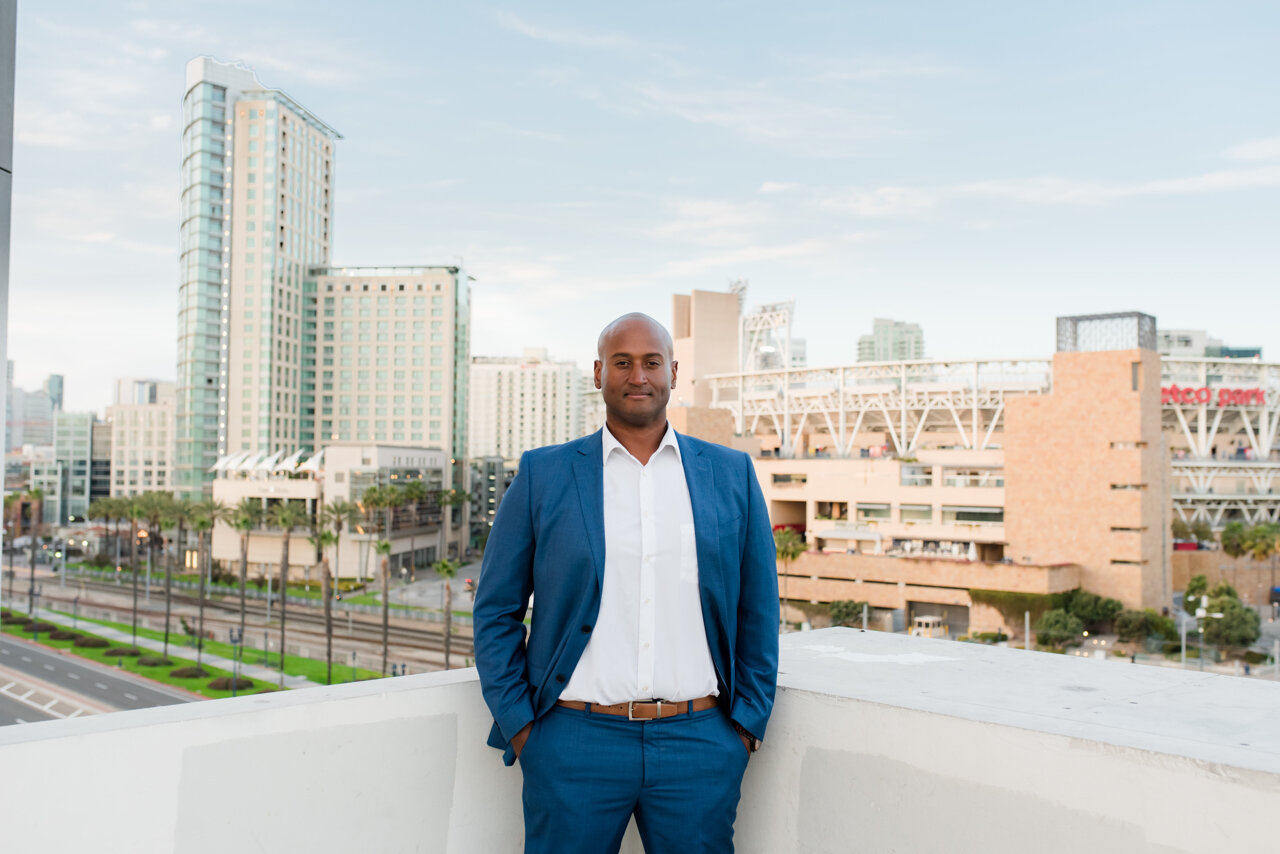
Jamal Brown is the CEO of The Ocean Company, an exclusive tenant representation firm with offices in San Diego, Orange County and Los Angeles focusing on the leasing and acquisition of commercial real estate.
Main: 858.356.2990 | E-mail: jbrown@theoceanco.com | social: @theoceancompany

How to Maximize Rent Abatement
How to negotiate free rent on your commercial lease in a tenant’s market that exceeds the typical market deal.
RENT ABATEMENT: The period of months where you the tenant do not pay base rent (expenses are still accrued) as a concession to signing a multi-year lease. This usually gets capped out at a maximum of one month of abatement per year of term.
But what if you could convince a landlord to give you additional rent abatement in the form of a rent credit?
If you negotiate a robust Tenant Improvement allowance that covers your construction bids, but then value engineer the cost of that construction to be less than the estimate you based your TI allowance off of; shouldn’t you get to use the money saved? The answer is YES but you have to negotiate that language into your lease. This helps offset your initial rent obligation, or can even be applied to buying new furniture or fixturized equipment. You just have to know what to ask for.
If you’ve got questions about leasing or purchasing commercial real estate, we’ve got answers.
Jamal Brown is the CEO of The Ocean Company, an exclusive tenant representation firm with offices in San Diego, Orange County and Los Angeles focusing on the leasing and acquisition of commercial real estate.
Main: 858.356.2990 | E-mail: jbrown@theoceanco.com | social: @theoceancompany

Urban Life Science Hub to Emerge in Downtown San Diego
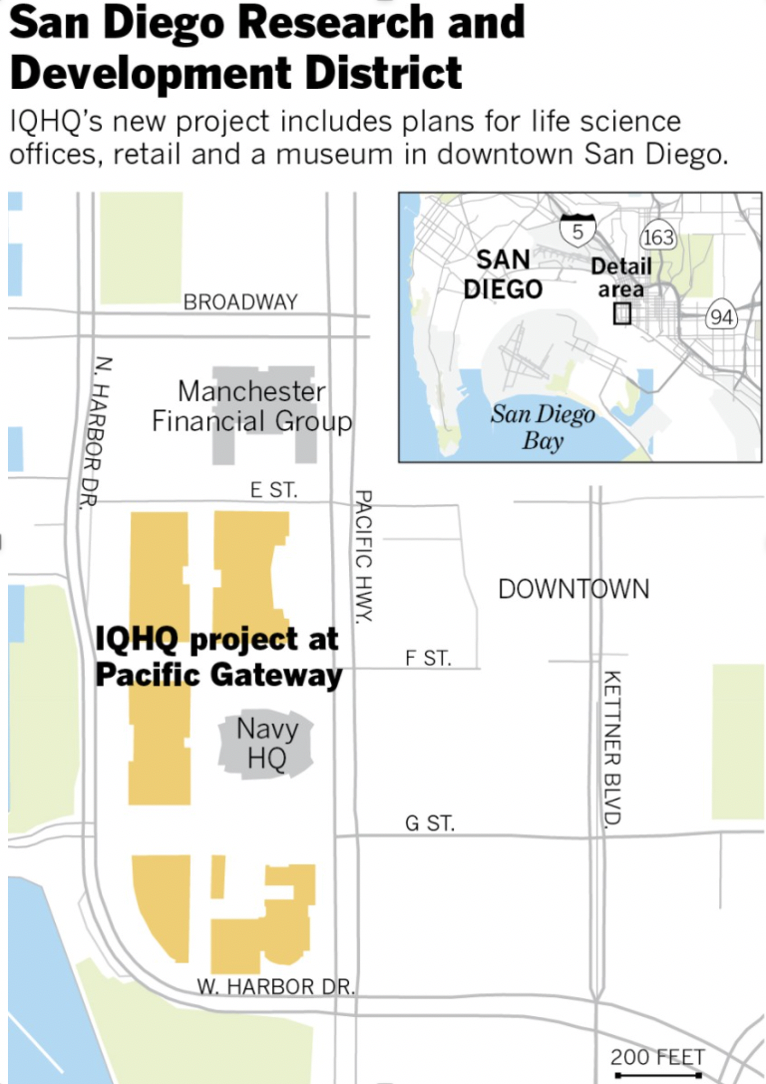
Downtown San Diego welcomes sprawling life science campus on site of Manchester's Pacific Gate development. New commercial real estate development in marina district meant to diversify the tenant mix in the downtown submarket hopes to attract Top 50 biotech tenants.
IQHQ has closed on a majority of Manchester’s long-awaited development in San Diego’s Marina District, Pacific Gate. Once marketed as a grand mixed-use office/retail/hotel project with public space component, the project is perhaps the biggest development derailed by recessionary fears & Covid to-date. In steps Alan Gold and his new life science real estate investment group, IQHQ. Gold is no stranger to the Life Science facilities, he co-founded BioMed Realty trust, a life science facility development company he sold to Blackstone Group for a reported $8 billion in 2016. With this acquisition, IQHQ shifts the vision of the project to become San Diego’s first urban life science center. Dubbed RaDD, the San Diego Research and Development District will have unmatched views, open space, and retail amenities aimed at attracting top 50 life science companies. Manchester will retain two of the site’s eight blocks and continue developing one of the two planned hotels and 1.9-acre plaza, although the firm did not share a timeline for construction.
At the moment, construction isn’t scheduled to commence until 2021, with the district’s first phase complete in Q3 2023. Plans include a series of mid-rise structures and one 17-story tower, a museum, 3 acres of public green space and rooftop decks. The Navy’s 372,000 SF office on-site is complete and move-in ready.
The question on everyone’s lips is ‘why’.
Based on San Diego’s standing as the number 3 life science hub in the nation, with demand still driving development and an increasing number of existing pieces of industrial product being converted to satisfy their needs; new supply is needed. Existing life science hubs in Sorrento Valley, Torrey Pines and Carlsbad are achieving high rents and show no signs of stopping even through the recession and pandemic. So then, why downtown which is a minimum of 13 miles from any of these hubs? Downtown San Diego recently attracted UCSD’s expansion campus, paving the way for a more research-oriented business and resident mix. Downtown San Diego offers accessibility to a myriad of public transportation services including the new San Diego Trolley Blue Line which will connect Downtown to San Diego’s Life Science Hub in Torrey Pines near UCSD, the Green Line which connects it to SDSU, and also a half-hour train ride to the Solana Beach area. The Marina district also has a planned redevelopment of Seaport Village which would add even greater retail offerings as well as public space to the area. Add to all that the numerous multi-family developments in the area and the project suddenly makes more sense.
But isn’t downtown mainly an office hub?
Today the answer is ‘yes’. The roughly 1.5 million square feet of new office construction in the submarket may be tough to lease given the pandemic/recession In fact, multi-tenant office leasing is off over 50% year over year in the submarket, and new deliveries have yet to do any substantial pre-leasing. An urban waterfront science park could be a big draw for the Pfizer/Alexion/Roche/Merck of the world, and smaller companies would be sure to follow when large anchors are landed. Amongst the commercial real estate community there are rumors both Parallel Capital Partner’s current redevelopment of Horton Plaza is shifting to a life science use, and the recently sold Thomas Jefferson School of Law building as downtown's office market now appears over-built. All factors included, you can see why a more diverse tenant mix is needed.
Jamal Brown is the CEO of The Ocean Company, an exclusive tenant representation firm with offices in San Diego, Orange County and Los Angeles focusing on the leasing and acquisition of commercial real estate.
Main: 858.356.2990 | E-mail: jbrown@theoceanco.com | social: @theoceancompany
Office Occupiers Eye a Return To The Workplace
Recent interview w/the CEO of an international commercial real estate firm provides some insight while raising some interesting questions.
1. If the return to the office is a collaboration/new hire on-boarding/company culture play; how do we consistently promote company values/build team dynamics when the space is utilized fractionally?
2. It appears we will be moving towards greater square footage per employee, thereby increasing the overall office footprint. Does this mean we should expect to see a flight from quality due to rents? Larger footprints = increased overhead = reduced profit margins. What does this do to the class A office market?
3. Current uncertainty & its effect on leasing decisions should prompt landlords to offer robust concessions packages to tenants that will make long term commitments, however, we aren’t seeing that yet. When do landlords accept that we’re in a Tenant’s market?
Unfortunately, no one has all the answers. I am interested to hear your thoughts.

Jamal has negotiated thousands of leases on behalf of tenants since 2003 and continues to advise companies on their on-going real estate strategies.
How Parking Effects Your Business
Lets talk about: PARKING
We all hate parking far from the entrance to the restaurant, store, gym or workplace. Sometimes lack of parking stops us from even visiting these establishments...ok not work but you know it’s still annoying. Here is a breakdown by sector on how parking effects your patronage.
Retail: While this might be intuitive for suburban retailers who often enjoy 5.0/1,000 sf leased parking ratios, there are certain operators, like gyms, who need customers to be able to park and be a 30 second walk to the front door. In my experience w/@lafitness the time it takes to get from car to club is a huge factor in whether or not people visit your location. Urban retailers don’t always have the luxury of on-site parking and should locate in either a “destination” zone (most frequently traveled blocks) or nearest to public parking as possible.
Hospitality: similar in discussion to retailers, however, suburban sites should have “express” or “to-go” stalls adjacent the ADA stalls at the facility. Covid makes taking over your parking lot a necessity right now, but your to-go delivery speed is a still a factor...besides, who wants to pay Grub Hub, Uber Eats or Postmates 30% of your sale?! Urban food & beverage operators primarily want to locate where the people are and where their concept isn’t over saturated. Let’s face it, city living forces you to walk and we will gladly do so to get to our favorite places.
Office: for office tenants, parking can be a financial component that effects their bottom line. Most suburban office parking comes free of charge, except for you Santa Monica. Urban office parking can run $100-$300/stall/month and subsidizing your employee parking charges will substantially increase your monthly overhead.
Whatever sector you fit into, parking is an aspect of the real estate selection you need to pay attention to in order to ensure overall success.


Experiential Retail and Mixed Use Communities Shape San Diego
From an employers standpoint Mission Valley was viewed as an accessible, yet unattractive submarket between downtown and UTC. These new developments will strengthen the area opportunity for a greater live/work atmosphere, as well as a recruiting hub.
If you haven't been paying attention to what is going on in Mission Valley let me help you.
SDSU was awarded the redevelopment of Qualcomm stadium (RIP Chargers) and will be expanding their campus presence, creating a new stadium, hotel, student housing, and 95k SF of retail as well as creating a public open space park.
Civita, the sustainable "city within a city" has completed phase one including housing, experiential retail and restaurants, and a 14.3 acre park. The development is pushing forward with phase 2 of its retail development.
Finally, Hines is redeveloping the Riverwalk golf course as a forward thinking, mixed-use community with over 90k square feet of retail, a 50 acre river park and 4000+ homes.
The fact that all of these developments are directly accessible from the trolley line, which itself is expanding into UTC, will truly connect San Diego neighborhoods in a way employers find beneficial. From an employers standpoint Mission Valley was viewed as an accessible, yet unattractive submarket between downtown and UTC. These new developments will strengthen the area opportunity for a greater live/work atmosphere, as well as a recruiting hub.

Signs we've entered a tenant's market
Significant write down and sale of the U.S. Bank Tower, an iconic DTLA office property leads me to believe a few things.
🏢 Sluggish leasing activity as a result of the recession and the pandemic is cause for concern to landlords whose rent rolls aren’t showing long term stability.
❓Shadow vacancy, again as a result of the pandemic and recession, could result in a tsunami of new-to-market subleases further hampering velocity in leasing activity.
💰 Overwhelming signs that we’re at the end of the “landlord’s market” cycle mean future lease economics will be more tenant friendly including robust concessions packages.
Although we aren’t currently seeing a direct effect of economic stagnation reflected in leasing rates throughout Southern CA, I am sure 2021 will mark the beginning of a fresh cycle in the office market.

Work-From-Home: Silver Lining or Death Knell for Commercial Real Estate?
Work From Home may save the Retail and Multi-Family sectors of commercial real estate.
Google extended 'WFH' through Q3 2021 & while the effect could be negative across the office/retail/multi-family sector if additional employers react similarly; there could be a silver lining.
Now this is an unpopular opinion but stay with me. Working from home isn't the panacea for combatting C-19 in work environments it was made out to be. Lack of human (read: adult) interaction is hard on teams meant to collaborate, cultivating relationships with potential customers is difficult, and families are facing the fact that the kids probably aren't going back to school in a few weeks. However, this could halt the losses in the retail sector as employees venture out of the house to work and spend dollars usually reserved for commuting. Instead of fleeing cities the multi-family sector could see a flight to quality from households, and the office sector may see companies adopt larger footprints to accommodate social distancing norms.
All of these things could happen averting the disastrous outlook forecasted for the commercial real estate and small business in general. Alternatively, none of these things could happen and we're in for a rough 2 years. Thoughts?

Getting Above Standard Tenant Improvements
Do you want great space that helps define your business and attract new clients? Is your company culture important to hiring and retaining top talent? If any of these statements resonate with you, then you cannot afford to accept standardized tenant improvements.
Above standard tenant improvements are typically any material used to improve your space that is above the common finishes the building owner utilizes . Usually the building owner has a list or book of all standard paint carpet, lighting and other flooring finishes that they are willing to provide to improve their space with. These may not showcase your businesses image, align with your company culture, or provide current/potential clients an idea of the caliber of your services. Many architectural firms, law firms and technology companies (just to name a few) need their space to make an impression on everyone who walks through their front doors. An architect uses their lobby to speak to their design capabilities, lawyers use this & other meeting areas to set the tone for their prowess and other businesses use their interior common areas to reinforce their brand & company values.

Achieving a certain look and feel beyond what a landlord is offering typically comes at an additional cost of construction. For example: building out 5,000 sf with building standard finishes may run $60/sf ($300,000); however, your company may want to add design elements to part or all of your space that will increase that number to $85/sf ($425,000). The $125,000 delta between these two numbers can be covered in the following ways.
Tenant pays for the difference: now most tenant rep brokers hate this as it isn’t ideal for companies without a large war chest. It consumes the tenant’s capital upfront and can typically be used better by the tenant to grow their business. In the event the tenant outgrows their space ahead of the natural lease expiration, they’ve sunk capital improving a space they didn’t use for the duration of their lease.
Landlord amortization of the difference: this is the most common solution to a tenant improvement overage. The landlord factors the additional cost of the tenant improvements into the tenant’s rent over time. This keeps the tenant from paying for the improvements upfront but does raise their monthly/annual rent obligation. This can be accomplished as a $/psf rent increase or an annual percentage increase. Think of it as a loan on the difference from the landlord. Does the landlord make a return on this loan...of course. Does the tenant lose if they outgrow the space ahead of the lease expiration? Yes, but not as much as if they pay out of pocket for the improvement difference up front.
Covering the difference through a loss in concessions: this is by far the most complicated and situation specific solution. If you have a savvy tenant representative, who knows your improvement costs will overrun a standard market landlord contribution; they will negotiate a robust rent abatement package, then reduce that once the improvement costs are known so that your rent cost/sf doesn’t increase dramatically. The drawback here is that most businesses use the rent abatement period to offset moving, furniture and other soft costs associated with new space. If those costs are minimal, this may be the best option for a business needing above standard tenant improvements.
*Value Engineering: while not always strategy for covering the cost difference in negotiations, having a great project manager or construction team working with your business & tenant representative to cut construction costs after you’ve secured a certain $/sf in landlord supplied improvement funds can be to your benefit. Make sure your tenant representative negotiated a clause which allows your business to utilize any unused funds in the form of full or partial rent payments.
If you need any help finding or negotiating on space, call us. We’re here to help. #findYOURspace
Avoiding Percentage Rent
If you’re an office tenant skip this one, it thankfully doesn’t apply to you - restaurant and retail space users should take notes. Your landlord is like that disgusting troll under the bridge in the story your mom used to read you. They want more than what’s fair because they think they’re in control. You’re about to pay them a monthly amount of rent, and your share of property taxes, property insurance and common area maintenance, in order to operate your business in their property. In addition, or sometimes in lieu of, they want their grubby little hands in your pocket by charging you a percentage of your (typically) gross sales...sometimes above a breakpoint but sometimes from the first dollar you earn. This is called percentage rent, and it’s absurdly legal.
As a rule of thumb your restaurant or retail store should never lease space that costs more than 6 - 10% of your projected gross sales. Seriously. Landlords who believe you have the ability to make millions of dollars in annual revenue in their space will try to parasitically attach themselves to your success using an overage percentage (DM me for details) or an absolute gross sales breakpoint on top of your rent. Whatever you sell above this breakpoint gets multiplied by your percentage and goes to the landlord. Seriously. Avoiding this is tough, but not impossible. First, know the conversation needs to be had upfront in lease negotiations and either make the percentage based on sales of something specific: i.e.: food sales, alcohol sales, super high end product you sell few of; or make your breakpoint so high you are UNLIKELY to hit it. Second, make the percentage a low number. Landlords are going to try something between 5 - 7% but it’s okay to laugh at them and offer 2 - 3%. Do not be afraid to walk away from the negotiating table in order to do this. Far too many restaurant owners fall in love with space and just agree to this nonsense. Unless you’re Tiffany’s you should stay far away from leases like these without protecting yourself, and if you need help, call us!

Jamal Brown has represented commercial tenants in lease negotiations for over 16 years.

5 Leasing Tips We Can Learn From Dogs
The two most persistent beings in the universe have to be dogs and children. Why are these little cutthroats so good at getting what they want? Here’s a few take aways we can we apply to the commercial leasing process which should help your company get what it needs.
Explore all your options: Dogs will stick their nose in everything just to figure out if it’s edible. At the onset of facility negotiations, you need to enroll as many desirable locations as possible. You also need to ask for everything that would make a facility contract compliment your business plan. Be strategic in the structure of the financial terms and the amount of exposure so your business can thrive.
Be Persistent: Ever had a dog beg for snacks/your dinner/belly rubs/a walk and then give up after one rebuke? Me neither. So when you don’t get a positive initial response to your requested lease terms, ask again. You may need to modify the language a little but go for what your business needs until you get it.
Play Dead: With a little training, dogs will do this for a reward. Sometimes it’s necessary in lease negotiations to take a step back, act offended, and let a landlord think their negotiation strategy killed a deal. More often than not you’ll reap the reward.
Leave Nothing Left: Whether it’s treats or steak bones, dogs rarely leave anything unfinished. Real estate costs are usually the 2nd or 3rd most costly expense your business will incur. You owe it to yourself and your employees to mitigate the fixed costs and your exposure to additional charges in negotiations. Grind multiple locations down simultaneously and don’t leave money on the table. Use each site as leverage against one another. Push hard until there’s nothing left.
Trust Your Pack: Dogs are a pretty good judge of character, and in their pack (human or canine) everyone plays their role. You need professional service providers throughout the leasing process. An experienced tenant representation broker to guide you through site selection and negotiation, a project manager to assist with construction pricing, scheduling and vendor coordination, and an attorney to negotiate and review lease language. Not only can you leverage these professionals to create the best outcome, you can spend more time focusing on your core business while they work for you. Lone wolves don’t accomplish much, you need a pack.

Jamal Brown is the CEO of The Ocean Company, an exclusive tenant representation firm with offices in San Diego, Orange County and Los Angeles focusing on the leasing and acquisition of commercial real estate.
Main: 858.356.2990 | E-mail: jbrown@theoceanco.com | social: @theoceancompany

Not All Buildings Are Created Equal
All commercial buildings are not created equal. One of the most overlooked aspects of a building’s value to the tenant is the efficiency of that particular building when compared to another. This efficiency is in relation to the ratio of the space the tenant actually leases within their four walls (the usable square footage) and the amount of space attributed to all common areas of the building including the lobby, hallways, restrooms, common conference rooms, common kitchen areas, interior break areas, work out buildings, showers/lockers, phone and electrical rooms, and any other common use area that, when added to the usable square footage, makes up the rentable square footage. This ratio is called the building “core factor” (also referred to as “load factor”, “loss factor”, or “add-on factor”). Understanding core factors translates directly to the bottom line. Since building costs are typically near the top of the expense list, the savings can be dramatic in comparison to other expenses. Pay attention to the core factor.

Why Your Tech Company Should Choose San Diego

San Diego has long been regarded as a sleepy seaside city, home to defense contractors, military bases, and the legendary zoo. Our 262 sunshine days and heavy attention on our thriving tourist industry has done little to combat this. While Silicon Valley has historically overlooked the startup community in America’s Finest City there are signs of a change in dynamics as the cost of living, and doing business in San Francisco and Oakland become unpalatable. In fact, San Diego has more entrepreneurs per capita than San Francisco and San Jose according to Inc. Magazine which ranked San Diego as one of the top 5 cities for entrepreneurs. So why should companies and capitalists consider San Diego the next tech hub? Here are our top five reasons to ditch the Valley for the beach.
The Talent
San Diego has a number of higher learning institutions which produce thousands of savvy, innovative graduates. UCSD is an extremely competitive school who’s average applicant has a 4.0 GPA. Currently ranked 41st overall in the 2019 edition of Best Colleges in the nation, UCSD is ranked 19th for computer science. Roughly 50% of their graduates are trained in biology & engineering. More VC-backed entrepreneurs are emerging from UCSD than from Boston University: UCSD produced 349 entrepreneurs who founded 330 companies and raised $5.73 billion from the start of 2006 through to the end of June 2018, according to research by PitchBook
Major collaborators with the university include companies like Glaxo Smith Klein and CIRM. San Diego State University is ranked 5th for information technology and 19th in California for computer science. The entrepreneurial community at SDSU is very active and its Lavin Entrepreneurship Center was recently awarded the Nasdaq Center of Entrepreneurial Excellence award by the Global Consortium of Entrepreneurial Centers (GCEC). University of San Diego is currently ranked 90th (US News & world Report) in the nation and its Shirley-Marcos School of Engineering is currently ranked 12th in the country. Clearly San Diego is home to many talented young minds equipped with skills in the industries of tomorrow and the entrepreneurial spirit.
Why is this important? The recruiting war for talent, engineering, sales, customer success, business development, marketing, etc., is far less competitive in San Diego than in San Francisco. In a recent article, 44% of San Diego millennial workforce was considering leaving the region due to a lack of career advancement and wage growth. The median household income in San Diego is $80,000, far less than San Jose or San Francisco.
The Cost of Doing Business
California is well-known for its tech regions in the San Francisco Bay Area (San Francisco, the outer Bay Area regions, and Silicon Valley) and Los Angeles (Silicon Beach and growing presence in Culver City); however, the cost of running businesses there (facility costs and labor) far outpaces San Diego. Renting commercial office space in both San Francisco and Los Angeles comes at a premium when compared to San Diego (May 2019, Costar) when comparing similar product across all classes. According to a December 2018 report by Brex, San Diego startups spend about $207,000 per month, which is far less than the $369,000 per month spent by startups in San Francisco.

From Brex: 2018 State of Spend, written by Chris Read
While a higher burn rate for a startup may be tied to areas with greater access to top-tier venture capital, it certainly doesn’t correlate to a stronger business model. Hiring talent in San Diego will cost employers less than the next two tech regions in California, and the workforce in San Diego expects fewer additional financial perks than their counterparts. Venture capital is choosing San Diego tech startups over life science/biotech investments as they require less money and have a lower valuation. San Diego startups raised the largest amount of venture capital in the third quarter of 2018 since 1995: $907 million. (Venture Beat )
When considering their capital allocation and future reinvestment, many angels/funds will choose early stage tech companies. Once the next round (enter Private Equity or Softbank) is secured this provides greater liquidity.
Why is this important? San Diego’s superior cost of doing business means your company will experience greater growth over the same period by securing A players at a lower price tag. Even with the desire for higher wages from the San Diego millennial workforce, the cost of obtaining the best-of-the-best is an improvement over San Francisco.
The Growing Tech Community
San Diego has long been known the backyard for companies like Qualcomm and Illumnia. While large companies like these do employ a significant part of the tech/biotech community, they also inspire new businesses in the region. A number of startup companies founded by ex-Qualcomm employees have successfully grown over the years and spread the tech community footprint. San Diego’s tech community is split geographically into three regions; Carlsbad, Sorrento Valley/UTC, and Downtown. While these regions currently don’t interact as cohesively as The San Francisco Bay Area, semi-annual events like Startup Week and events held by San Diego Venture Group, Foundrs, ThinkTank, and Tech Coast Angels have incredible turnouts. Larger companies like Apple, Amazon and Dropbox have recently increased their presence in the region. Amazon expanded into an 85,000 SF facility and is developing a facility near the US/Mexico border on a 2 Million SF facility. Apple leased 97,000 SF (UTC) announcing it plans to hire 1,200 employees in the region over the next three years. In addition to this, incubators with backing from giants like GSK have increasingly played a role in the growing startup community. The increase of large co-working operators in all three tech regions continues to drive community as small businesses within leverage each other through their early stages. Co-working operators similar to Wolf, who watch their tenant’s grow may invest in them becoming a capital source in the angel round.
The Future
The relocation of companies like Bizness Apps, Wrike, and others have real estate developers launching speculative projects to court tech businesses. Stockdale Capital Partners recently won approval to convert downtown San Diego’s Horton Plaza into a 772,000 SF high tech campus. The project is estimated to create 4,000 jobs and build on the existing tech community in the area which already boasts 140 startups. Projects like Superblock, Makers Quarter and UCSD (which has a new campus underway downtown) are increasing the infrastructure needed to attract more tech companies and investment dollars. San Diego has all the necessary components to become the next west coast tech hub. The question is no longer ‘if’ but when.
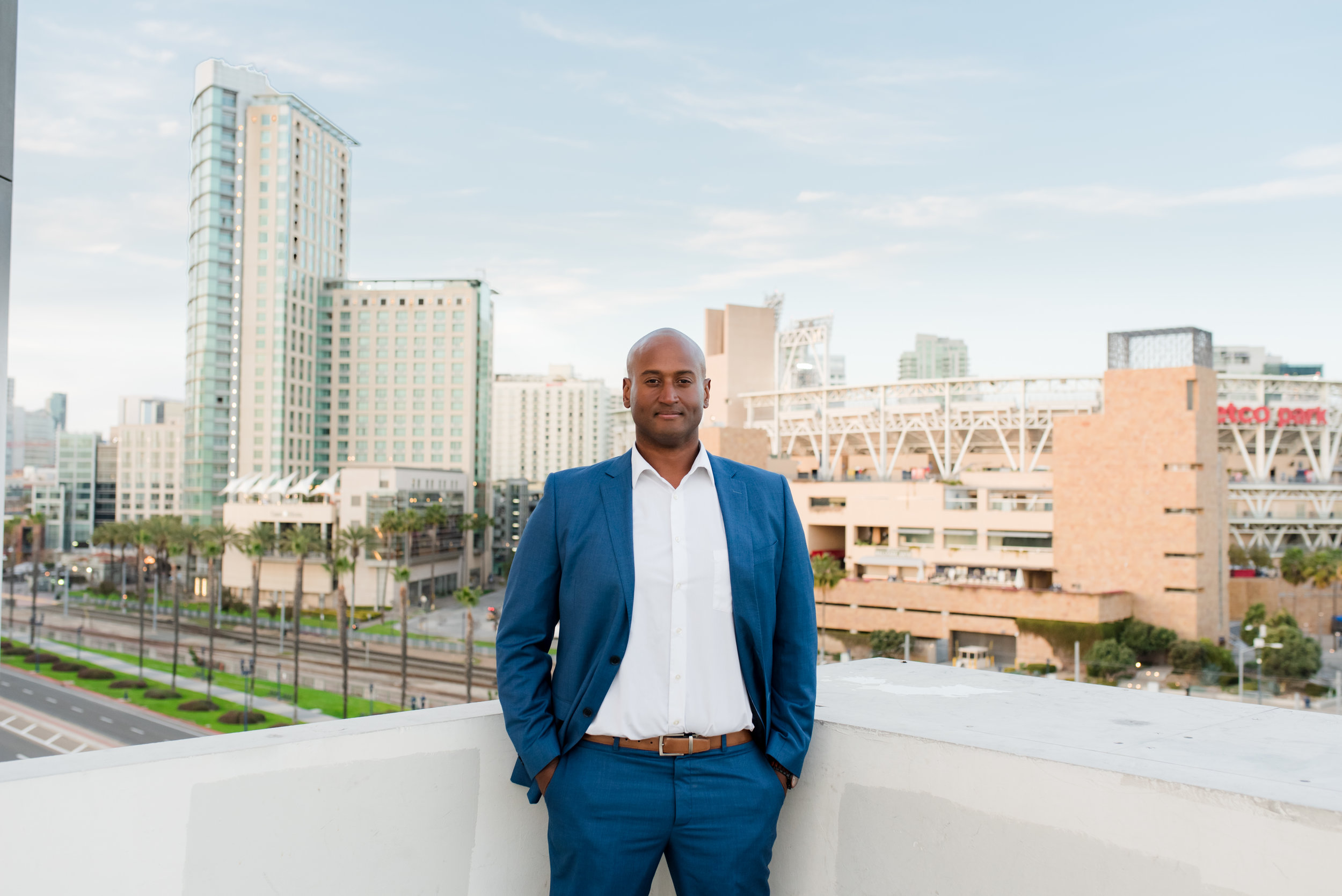
Jamal Brown is the CEO of The Ocean Company, an exclusive tenant representation firm with offices in San Diego, Orange County and Los Angeles focusing on the leasing and acquisition of commercial real estate.
Main: 858.356.2990 | E-mail: jbrown@theoceanco.com | social: @theoceancompany
5 Reasons You're Not Attracting Talent

Employers are experiencing difficulty matching open positions with extraordinary talent.
If your organization is having trouble attracting the best talent for the job you may be facing the following five common problems. Never fear, we've got a few solutions that will help your company stand out amongst the competition.
1. Obscurity
During the Great Recession when jobs were scarce, employers could be selective about hiring the best of the best. We are currently at the height of the economic cycle and there are plenty open, well paying positions. Talent has to be wooed by more than money, you need a great company culture and job-related perks. In addition to all this you need to spread the word about these aspects of working with your business. If top talent doesn’t know about these aspects of your business through social media or your presence in the community you’ll have a tough time attracting them.
2. Workforce Fulfilment
The millennial workforce wants to feel like their efforts are having an impact. The solution to attracting the cream of the crop is in making sure your open positions have compelling descriptions tied into the overall company mission. It doesn't hurt to have a socially responsible company ethic either.
3. Location, Location, Location
You may have heard this mantra in real estate, but it also applies to workplace desirability. Today's young professionals tend to flock to desirable, often urban areas in walkable distance to social centers. These typically exist within densely populated hubs, and if you aren’t in them or nearby, you’ll have a hard time gaining their interest.
4. It’s all about your space
While you may not need a Facebook or Google style campus, your space says a lot about the company culture and what it’s like to work there. Does your space encourage collaboration, innovation, is your leadership accessible, and is the company brand reflected in its design? You never get a second chance to make a first impression so pay attention to what your space says about you.
5. Do everything you can to keep existing talent
Sounds like a no-brained but your competitors are trying to recruit your talent daily. Not only that, but word of mouth about what it’s like to work with your organization may be dissuading other talented professionals from joining your team. Make sure your team is happy and well compensated. Develop with a strategic plan to improve employee engagement, heck, buy them lunch. Creating this type of work environment will land you referrals to other talent from your existing team, and your clients. Be prepared and aggressive and you’ll stand out amongst your industry peers, and talent pool.

Jamal Brown is the CEO of The Ocean Company, an exclusive tenant representation firm with offices in San Diego, Orange County and Los Angeles focusing on the leasing and acquisition of commercial real estate.
Main: 858.356.2990 | E-mail: jbrown@theoceanco.com | social: @theoceancompany
5 Metrics You Need To Know

So you think you’re ready for an additional location and are prepared to spend the time, capital and effort to expand. We have all heard the ‘location, location, location’ mantra, especially when it comes to retailers and restauranteurs; but there is much more to successfully expanding your offering than this. Truly understanding the business metrics in your current location Is beneficial to finding the right location to occupy. The five business evaluations below will help you and your business determine what space is right for your next location.
When planning any expansion of your brand, knowing the true occupancy cost of your business is essential for the success.
1.Revenue generating space: Unlike the majority of office or industrial users, retail and restaurant space occupiers generate income on a much smaller percentage of their rentable area. Space usable for displaying goods, seating customers, or other “front of house” activities is typically in the 50%-60% range. The effective cost of occupying space is derived from dividing your revenue over this percentage of your square footage. In the case of restaurants, the kitchen is absolutely an important component in generating income; however, when planned correctly this space is typically less than 20% of the entire establishment footprint. When planning any expansion of your brand, knowing the true occupancy cost of your business (revenue divided by that percentage of your space that generates income) is essential for the success. The cost for a potential new location should be examined utilizing these metrics.
2. Revenue as a percentage of your Facility Cost: Your facility cost is generally the second or third line item on your balance sheet, but identifying the cost of your facility in relation to the revenue you generate from it is a key metric needed for smart expansion. Your annual revenue/annual facility cost (Base Rent + Operating Expenses + Utilities) will provide a benchmark you can apply to potential future sites.
3. Effectiveness: Business owners can evaluate your actual annual occupancy cost metric by dividing your sales by the establishment’s selling space. While this can also be done by dividing the annual top line revenue by the gross square footage it is more useful to use the revenue/selling space formula if you wish to apply this to other locations. Remember, not all spaces are equal due to inherent space shape efficiencies.
4. Demographics: We all know local population income and age numbers matter; however, you may be operating in a ‘destination’ center wherein people from surrounding areas frequent often as a result of commute or travel. It is thereby important to understand the demographics of YOUR customers. While the neighborhood, average traffic counts, and proximity to other similar retailers does have an effect on your success, knowing: who, why, when and how your revenue is generated will provide guidance should you expand.
5. Discounting: Probably the least exciting topic but one of the most important. Taking the number of sales at discount or special pricing and dividing it by the total sales (Discount Sales/Total Sales) is necessary when developing a stores profile. Restauranteurs who have to offer heavy discounts/specials to get people in the door rarely have the necessary capital or financials to expand. It’s common knowledge that food margins are slim, and if you’re discounting your per plate costs there better be an avenue to make up for it., i.e. alcohol sales. Retailers offer discounts based on seasonal changes or specific items that aren’t moving, however, the percentage of a store’s discounts should remain consistent. If this percentage increases quarter over quarter (not just seasonally) it’s indicative of a problem.

For both restauranteurs and retailers knowing these metrics can help correctly identify geographic areas, and specific sites, suitable for expansion. Performing this front-end analysis will save you time, money, and prevent you from committing to the wrong space. If you have any questions related to expanding your brand into new locations call us for a free consultation.
Does a Modern Office Space Need a Kitchen/Break Room
Office space occupiers often wonder if creating a kitchen or break room within their workspace is necessary. Commercial Real Estate expert Jamal Brown breaks down the reasons why designing a kitchen or a break room as an additional meeting area within your office space may be the best solution. Finding a tenant representation broker that knows how to maximize your usable square footage and use your space to support the company culture is key. If you have any questions on our office space design recommendations, feel free to call us. The Ocean Company is a team of commercial lease and property acquisition specialists with offices in Los Angeles, Orange County and San Diego California.
Protecting Your Business From Supplemental Tax Bills
As a tenant occupying a commercial building you are paying your proportionate share of that building's common area maintenance, property taxes, and property insurance. The way these property expenses are billed to your business varies depending on the type of lease structure you have negotiated. NNN lease structures pass all cost through to their tenants directly, Gross leases have a base year (cumulative actual expenses needed for the building in that particular calendar year) for calculating a tenant's exposure to building maintenance costs and then any expenses over the base year expense value are billed back to each tenant based on their pro-rata share. In Q4 2018, commercial real estate values are at an all time high. Property owners are selling their real estate for a profit but as a tenant, this means you are going to receive a higher assessed property tax value after the sale. In short you're occupancy costs are going to increase due to the sale of the property. There are way to protect yourself and your business against these costs. If you're interested in finding out how, contact us. We can help. 858.356.2990
How To Convert Warehouse Into Office Space
Many small businesses and startups are being choked by rising commercial real estate pricing. Rents are currently at or above pre-recession prices, making companies choose between their facility, or expanding their business. There are options out there for users of office space who want "cool" or creative work-spaces, and we wanted to share one with you. Converting industrial warehouse space into a usable office work-space is achievable with a few minor changes. The two items which need the most attention are climate control, and light. Adding some sort of cooling air circulation will greatly change the atmosphere of a warehouse work environment. Replacing solid doors with glass, and reducing the number of walls within the entire space will allow more ambient light to flow through the work space.

Neighborhood Spotlight: Liberty Station/ Point Loma
Point Loma and Liberty Station
Neighborhood Business Spotlight: Brick San diego

Image by @andy_king_photography
Business Spotlight: BRICK SAN DIEGO: Liberty Station’s premier event venue
Brick San Diego is an event venue comprised of 6,000 sf of open space located in Point Loma’s Liberty Station. This inviting event space is available for weddings, holiday parties, corporate events and more. Brick’s operators, 828 Venues, created a beautiful interior that can be transformed into anything a client dreams. Brick’s event planning team has been servicing the community for over five years, and can help you throw the best gala in Liberty Station. Here are five reasons to book this space and work with Brick’s team while planning your next celebration.
1. 24-hour Rentals: Take as much time as you need.
Understanding that event set up and execution can take more time than just a few hours, this unique event space allows for 24 hour rentals so you can set up without the time constraints that most other venues would impose.
2. Open Vendor Policy: Creative freedom, whether you want to DIY or not.
While many venues will maintain an exclusive list of vendors that you must chose from when planning an event, BRICK offers the option to bring in your desired vendors! Not only does this allow you to create the celebration of your dreams, it ensures that your gala will be unique and memorable. They also have a list of vendors on call that are familiar with the space so no matter what you choose, this flexibility sets BRICK apart from the rest.
3. BRICK Coordination: Available to handle your every need.
Having an event can become stressful, especially if you plan to also be enjoying the party. Brick offers an exclusive coordinator for your day of needs and even can help with the planning process. While an outside coordinator can be helpful, having someone on site that knows the regulations and policies can alleviate so much stress!
4. Indoor + Outdoor Space: Extend the party outside.
One of the many benefits of having a space in Liberty Station is the ample use of outside space. There are several grassy areas, patios and the views of the downtown skyline are unbeatable. When you have an event, allowing people to move between indoor and outdoor space can extend the ambiance.
5. #BRICKBeverage: Bar service curated to your tastes.
BRICK offers a catered bartender service so that you don’t need to worry about your guests having cocktails. Not only is service included with the many package offers, it takes an extra step out of the planning process so that you can enjoy your event without breaking the bank!
Point Loma Market Statistics
The Point Loma submarket is a mix of office and retail space that retains a small community feel. With older product outside of Liberty Station, there are many unique options for commercial space build outs. Liberty Station and it’s recently redeveloped military housing complex is undeniably one of the most unique offerings in the city of San Diego. The tenant mix ranges from schools (High Tech High), the famous Public Market, multiple restaurants, shopping establishments, religious facilities, and professional services.
Recently, McMillan sold it’s remaining 66 year master lease on the retail component in Liberty Station to Pendulum Property Partners. This includes all the
restaurant and retail spaces in the project.
Below are some Point Loma submarket statistics.
Retail Space Data:
Construction: 9,000 square feet of space expected to be delivered by Q4 2019
Sales: Average price of $388 per square foot
Vacancy rate: 3.2%
12 month rent growth: 2.2%
Office Space Data:
Median Sale price: $2.1 million
Sales: Average price of $225 per square foot
Vacancy Rate: 4.8%
12 month rent growth: 4.3%
Considering Point Loma or Liberty Station as a location for your business? Hire an expert you can trust. For more information on commercial real estate in Point Loma or Liberty Station, contact us and we can help you find the best space for your business!
